Table of Contents
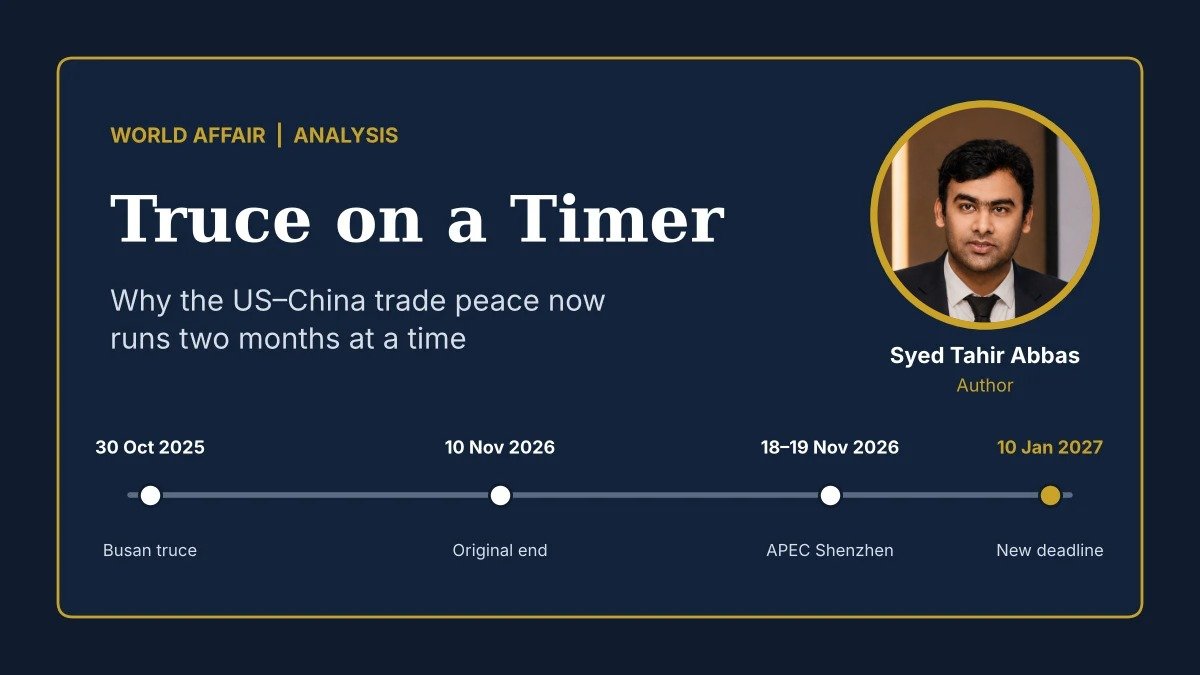
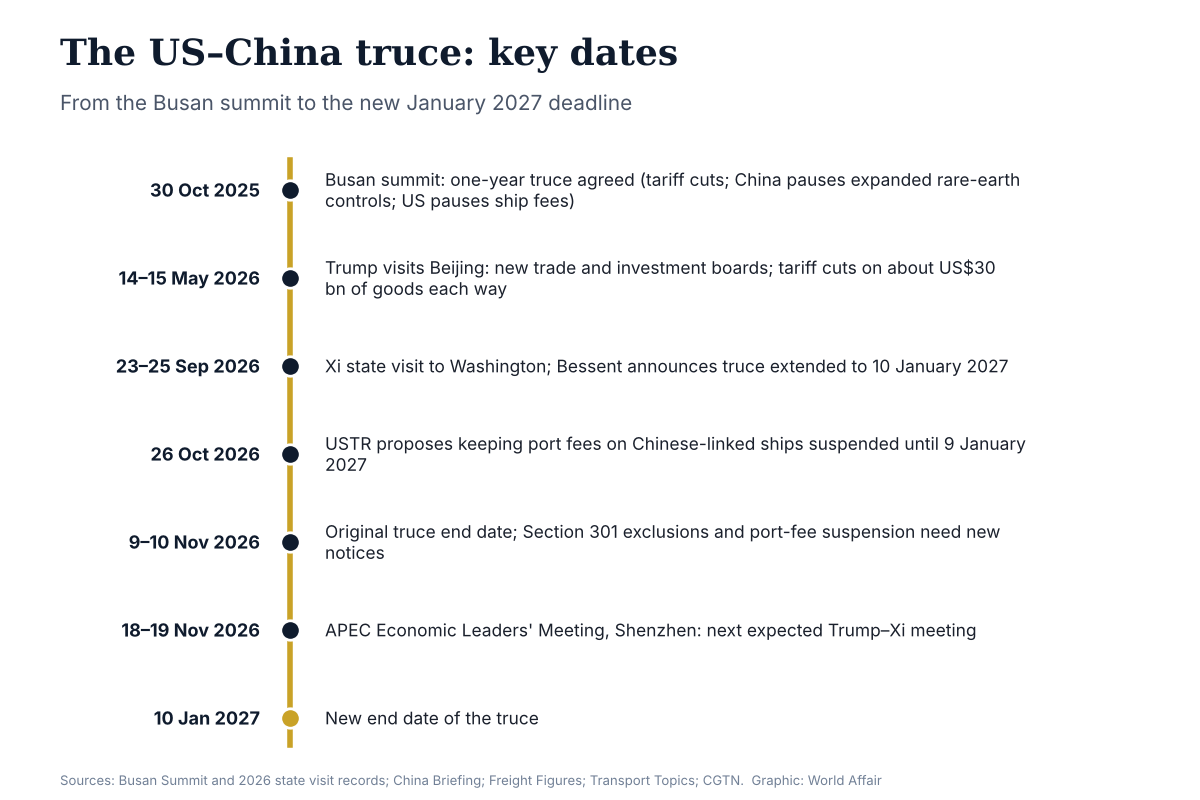
One year ago, on 30 October 2025, Donald Trump and Xi Jinping met at Gimhae International Airport in Busan, South Korea, and stopped a trade war that was about to get much worse. Washington cut its tariffs on Chinese goods, and both sides paused their newest weapons: China its expanded controls on rare-earth exports, and the United States its fees on Chinese-built ships and some of its export-control measures. The deal was meant to last one year, until 10 November 2026.
That deadline has now been pushed back, but only a little. On 23 September, as Xi arrived in Washington for his first state visit to the United States in eleven years, US Treasury Secretary Scott Bessent announced that the truce would be extended to 10 January 2027. On 26 October, the Office of the US Trade Representative (USTR) followed with a notice proposing to keep the suspension of its port fees on Chinese-linked ships until 9 January 2027.
Two months is a very short time in trade policy. Why have the world’s two largest economies chosen to renew their peace in such small pieces, and what does it mean for everyone else, including Pakistan?
What was agreed in Busan
The Busan deal was a package of pauses rather than a full trade agreement. Its main parts were:
- Tariffs: the United States reduced the average tariff on Chinese imports from about 57% to 47%, and cut the special “fentanyl” tariff from 20% to 10%.
- Rare earths: China suspended, for one year, the expanded export controls on rare earths that it had announced in October 2025.
- Ships and ports: the United States suspended for one year its Section 301 action against China’s shipbuilding and maritime sector, including new port fees on Chinese-linked ships. China suspended its own counter-measures.
- Agriculture: China promised to resume large purchases of American soybeans and other farm products, including 25 million tonnes of soybeans a year from 2026 to 2028.
- Fentanyl: both sides agreed to strengthen cooperation against the trade in fentanyl and its chemical precursors.
Taiwan, the war in Ukraine and American controls on advanced chips were not part of the deal. In other words, Busan calmed the trade war, but it did not touch the deeper causes of the rivalry.
A year of summits, not a settlement
The past year has been unusually busy for US–China diplomacy. Trump visited Beijing on 14–15 May 2026. The two sides agreed to create new trade and investment boards, to cut tariffs on about US$30 billion of goods in each direction, and agreed on large Chinese purchases of American farm products and Boeing aircraft. Xi’s return visit to Washington on 23–25 September (see our earlier analysis, Xi–Trump Summit 2026: Can Managed Competition Survive the AI and Power Reality?) added a plan for an AI dialogue, a promised agreement on military crisis communication, and Chinese purchases of American coal.
But the hardest questions were left open. The Busan deal was never turned into a long-term agreement. Chinese guarantees on rare-earth supplies were not finalised, and the US Section 301 investigations into Chinese practices in shipbuilding and maritime logistics were paused, not closed. Washington approved exports of Nvidia’s H200 chips to China in January, but no wider agreement on chips followed. In May, Bessent said openly that Washington was “not in a rush” to extend the truce. In September it did extend it, but only for two months.
Why two months?
The short extension is not an accident. It reflects three things.
First, it keeps leverage on both sides. A one-year or open-ended truce would remove pressure. A two-month truce keeps the most powerful tools, Chinese rare earths and American export controls and tariffs, on the table. Each side knows the other can restart the conflict quickly.
Second, it buys time for the next meetings. The two leaders are expected to meet again at the APEC Economic Leaders’ Meeting in Shenzhen on 18–19 November, and the United States hosts the G20 summit in Miami in December. A short extension carries the truce to these meetings, where a larger package could be announced, or not.
Third, it is legally fragile. A leader’s announcement is not the same as a legal change. Many parts of the truce depend on separate notices in the US Federal Register. For example, the exclusions that protect 178 Chinese products from Section 301 tariffs were set to expire on 9 November 2026, and the suspension of port fees also needed its own new notice. This is why USTR had to publish a separate proposal in late October. Until each notice is in place, businesses cannot be sure what will happen in November.
What each side wants
For Washington, the main goals are secure access to Chinese rare earths, continued Chinese purchases of American farm goods, energy and aircraft, and Chinese action against fentanyl. It also wants to keep the freedom to use tariffs and export controls if talks fail.
For Beijing, the main goals are lower American tariffs, an end to the Section 301 cases against its shipping and shipbuilding industries, and fewer restrictions on Chinese companies and on access to advanced technology. China’s Ministry of Commerce has also raised a list of smaller trade complaints, from import alerts on Chinese seafood and dairy to the export of plants.
These goals overlap only partly. Both sides want stability, but each wants the other to give up its strongest weapon first. A two-month truce allows them to keep talking without either side making that sacrifice.
Who pays for uncertainty?
For Washington and Beijing, short truces are a way to manage rivalry. For the rest of the world, they create costs.
Shipping and freight. In 2025 the two countries imposed tit-for-tat port charges on each other’s ships, which raised freight costs and cost shipping companies millions of dollars. These fees are suspended, not abolished. Any exporter in Asia, Africa or Latin America that depends on Chinese-built ships or on trade with both countries is exposed if the suspension ends.
Rare earths and manufacturing. China dominates the processing of rare earths, which are used in electric vehicles, wind turbines, electronics and defence equipment. China’s pause on its expanded export controls is part of the truce. If the truce fails, factories far from Washington and Beijing could face shortages and higher prices.
Third countries in the middle. The truce protects China but not everyone else. Trade analysts have reported that a separate US investigation into “excess capacity” covers around sixteen economies, including Vietnam, Japan, South Korea, the European Union and India. Countries that gained factories and exports by moving supply chains out of China may now find themselves the next target.
What it means for Pakistan
Pakistan is a clear example of a country caught between the two economies. According to State Bank of Pakistan data reported for the 2025–26 fiscal year, the United States remained Pakistan’s largest export market, while China was its second-largest export market. At the same time, Pakistan’s largest trade deficit, about US$16.9 billion, was with China, because Pakistan buys large amounts of machinery, raw materials and components from Chinese suppliers.
This means Pakistan’s exporters earn much of their income in the American market but depend heavily on Chinese inputs. A collapse of the truce could hurt them from both sides: higher freight costs and disrupted supply chains on the Chinese side, and new pressure on third countries on the American side. Stable rules between Washington and Beijing are therefore in Pakistan’s direct interest. A truce that is renewed two months at a time makes long-term investment planning, for example in textiles or in projects linked to the China–Pakistan Economic Corridor, more difficult.
Three possible outcomes by January
1. Another short extension. This is the easiest path. Both sides renew the truce again for a few months, while talks continue. This avoids a crisis but keeps uncertainty high.
2. A longer framework. Trump and Xi use the APEC meeting in Shenzhen, or the G20 in Miami, to agree a deal of one year or more, with clearer rules on rare earths, tariffs and port fees. This would be the best result for the world economy, but it requires both sides to give up some leverage.
3. A return to confrontation. If talks fail, the paused measures could come back: higher tariffs, port fees and Chinese rare-earth controls. Markets, shipping companies and third countries would feel the effects quickly.
What to watch
Three dates will show whether the truce becomes something more durable:
- Early November: whether USTR finalises the extension of the port-fee suspension and the Section 301 exclusions before they lapse.
- 18–19 November, Shenzhen: whether Trump and Xi use the APEC meeting to agree a longer framework, including clear rules on rare earths and export controls.
- 10 January 2027: the new end date of the truce. If nothing larger is agreed by then, the world will learn whether Washington and Beijing prefer another short extension, or a return to confrontation.
Conclusion
The Busan truce has survived for a year, and that is an achievement. But a peace renewed two months at a time is not a settlement. It is a sign that both powers want calm without giving up their weapons. For the United States and China, this may be a rational strategy. For the many countries that trade with both, including Pakistan, it means living with constant uncertainty, and preparing for the possibility that the truce ends as suddenly as it began.
Frequently asked questions
What is the US–China trade truce? It is the package of measures agreed by Donald Trump and Xi Jinping at the Busan summit on 30 October 2025. The United States lowered some tariffs and paused fees on Chinese-linked ships, and China paused its expanded rare-earth export controls and promised large purchases of American farm products.
When does the US–China trade truce end? It was due to end on 10 November 2026. In September 2026 the United States announced that it would be extended to 10 January 2027.
Why was the truce extended for only two months? A short extension keeps pressure on both sides, carries the truce to the APEC meeting in Shenzhen (18–19 November) and the G20 in Miami (December), and gives time to complete the legal notices needed for each part of the deal.
How does the US–China trade truce affect Pakistan? The United States is Pakistan’s largest export market, and Pakistan’s largest trade deficit is with China. If the truce fails, Pakistani exporters could face higher freight costs, more expensive Chinese inputs and more uncertainty in the American market.
Sources
- Busan Summit (Wikipedia)
- 2026 state visit by Xi Jinping to the United States (Wikipedia)
- The Xi–Trump Beijing Summit: What Was Agreed and What Was Not, China Briefing
- US–China Truce Extended to 10 January 2027, Freight Figures
- US plans two-month extension to shipping-fee truce with China, Transport Topics
- APEC 2026 Economic Leaders’ Meeting in Shenzhen, 18–19 November (CGTN)
- US remains Pakistan’s largest export market in FY26 (24 News HD, State Bank of Pakistan data)
Author Profile

- Syed Tahir Abbas is a Master's student at Southwest University, Chongqing, specializing in international relations and sustainable development. His research focuses on U.S.-China diplomacy, global geopolitics, and the role of education in shaping international policies. Syed has contributed to academic discussions on political dynamics, economic growth, and sustainable energy, aiming to offer fresh insights into global affairs.
Latest entries
 GeopoliticsOctober 30, 2026Truce on a Timer: Why the US–China Trade Peace Now Runs Two Months at a Time
 GeopoliticsSeptember 21, 2026Xi-Trump Summit 2026: Can Managed Competition Survive the AI and Power Reality?
 GeopoliticsSeptember 7, 2026China’s New Front: Coast Guard Patrols East of Taiwan and the Quiet Expansion of Maritime Pressure in 2026
 Strategic AssessmentAugust 24, 2026The AI Choice Is Becoming Binary: Washington’s Push and Beijing’s Counter