Table of Contents
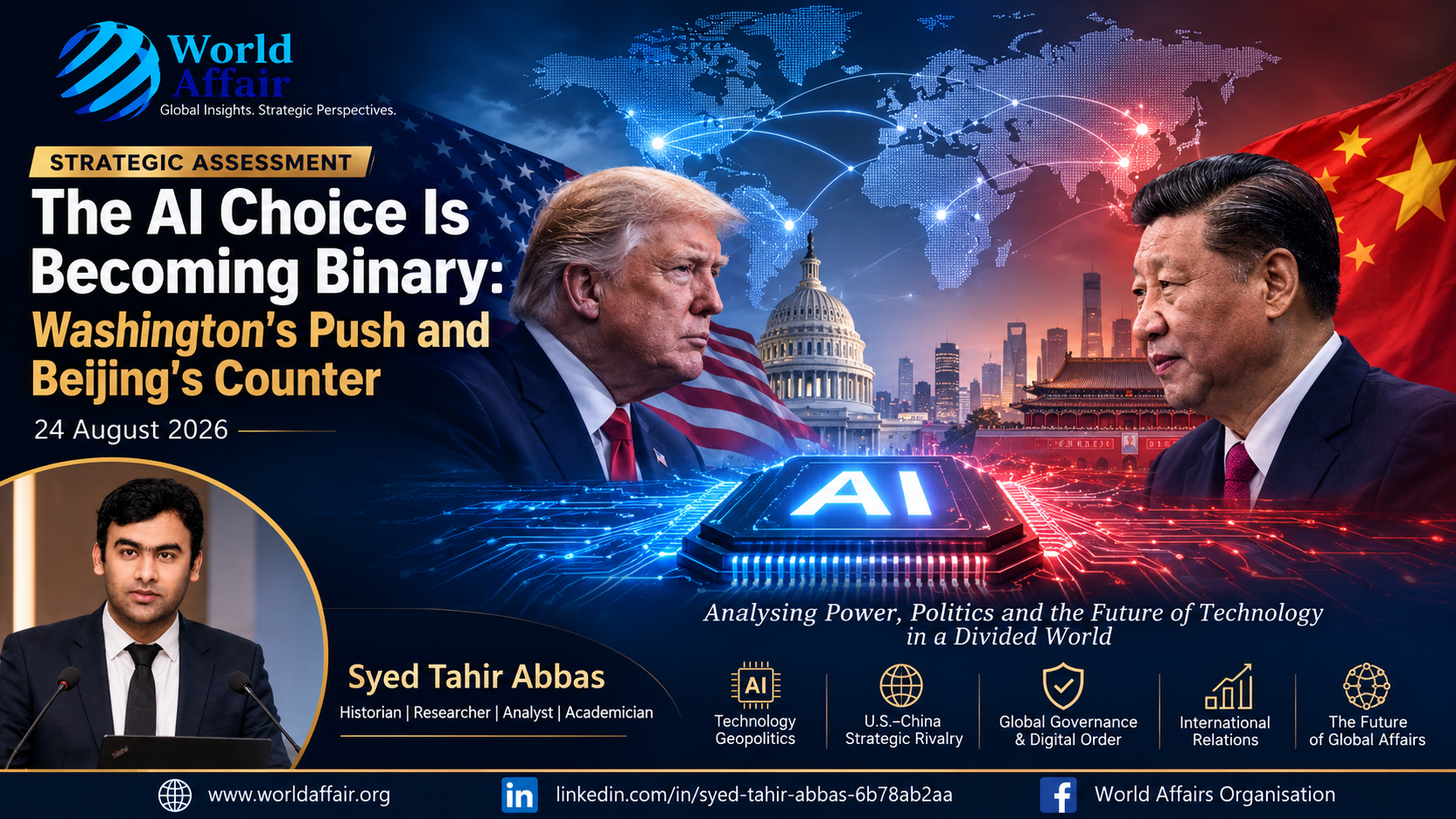
This week brought clearer evidence that the United States is moving from technology competition with China toward explicit coalition discipline in artificial intelligence. According to reporting based on internal drafts and official signals, Washington is preparing to press dozens of countries to align with a U.S.-led AI framework. Countries that also participate in Beijing’s competing initiatives risk exclusion from preferential access, standards cooperation, and related technology partnerships.
China responded quickly. Its foreign ministry rejected “camp-based” approaches and restated the principle of digital sovereignty, arguing that each country should choose partners according to its own development needs. The exchange crystallises a shift that has been building for months: AI is no longer treated primarily as a commercial or scientific domain. It is being organised as a strategic alignment issue.

Why This Matters Now
Three reinforcing trends make the current moment significant.
First, Chinese models continue to close the practical gap. Benchmark leadership still largely sits with leading American systems, but Chinese offerings are gaining ground on cost, deployment speed, and usability in many emerging markets. For governments and companies outside the core technology powers, “good enough and cheaper” is often decisive.

Second, both sides are institutionalising their approaches. The United States has advanced initiatives aimed at securing AI and semiconductor supply chains among trusted partners. China has promoted alternative frameworks emphasising openness, capacity-building for the Global South, and resistance to exclusionary blocs. Soft-law instruments—OECD principles, UNESCO’s ethics recommendation, and earlier G7 processes—continue to exist, but they increasingly sit alongside harder alignment pressures.
Third, middle powers and developing countries are being forced to calculate trade-offs earlier than many preferred. Multi-alignment remains attractive in principle. In practice, preferential access to advanced chips, models, cloud infrastructure, and standards processes may become conditional.
Strategic Implications
The emerging pattern resembles earlier technology-order contests, but with faster feedback loops. Export controls, standards competition, data governance rules, and investment screening are being used simultaneously. The result is not a single global AI regime, but parallel and partially competing architectures.
For decision-makers, several consequences follow:
- Technology policy is now alliance policy. Choices about model procurement, cloud providers, research collaboration, and data localisation carry clearer geopolitical weight.
- Hedging is becoming more expensive. Countries and firms that attempt to maximise access to both ecosystems may face rising compliance, trust, and market-access costs.
- Governance fragmentation is structural, not temporary. The soft-law layer will persist, but the hard choices about compute, talent, and standards are being shaped by strategic rivalry.
- Domestic capacity matters more. States with stronger indigenous AI ecosystems or diversified supplier relationships will retain greater room for manoeuvre.

Decision Points for Governments and Firms
Near-term choices will shape longer-term dependence.
Governments should clarify their risk tolerance for exclusion from one ecosystem versus constrained access to the other. They should also accelerate investment in domestic talent, data infrastructure, and regulatory capacity so that alignment decisions are not made from a position of pure dependence.
Companies need to map their exposure across model providers, cloud platforms, semiconductor supply chains, and downstream application markets. Scenario planning should include the possibility of sharper bifurcation in standards, licensing, and data flows within the next 12–24 months.
Investors and corporate strategists should treat AI partnership announcements as geopolitical signals, not merely commercial ones.
Outlook
The coming months will test whether Washington can convert pressure into durable coalition discipline and whether Beijing can expand the practical attractiveness of its alternative through cost, accessibility, and diplomatic outreach. Most countries will try to delay binary choices. The trend line, however, points toward narrowing room for ambiguity.
The strategic question is no longer whether AI will be shaped by great-power competition. It is how quickly that competition will force clearer alignment decisions—and how much autonomy actors outside the two leading ecosystems will retain while those decisions are being made.
Author Profile

- Syed Tahir Abbas is a Master's student at Southwest University, Chongqing, specializing in international relations and sustainable development. His research focuses on U.S.-China diplomacy, global geopolitics, and the role of education in shaping international policies. Syed has contributed to academic discussions on political dynamics, economic growth, and sustainable energy, aiming to offer fresh insights into global affairs.
Latest entries
 GeopoliticsSeptember 21, 2026Xi-Trump Summit 2026: Can Managed Competition Survive the AI and Power Reality?
 GeopoliticsSeptember 7, 2026China’s New Front: Coast Guard Patrols East of Taiwan and the Quiet Expansion of Maritime Pressure in 2026
 Strategic AssessmentAugust 24, 2026The AI Choice Is Becoming Binary: Washington’s Push and Beijing’s Counter
 GeopoliticsJuly 28, 2026South China Sea Crisis Deepens: China-Philippines Standoff and the Future of Indo-Pacific Order