Table of Contents
By Syed Tahir Abbas | World Affair | 22 November 2026
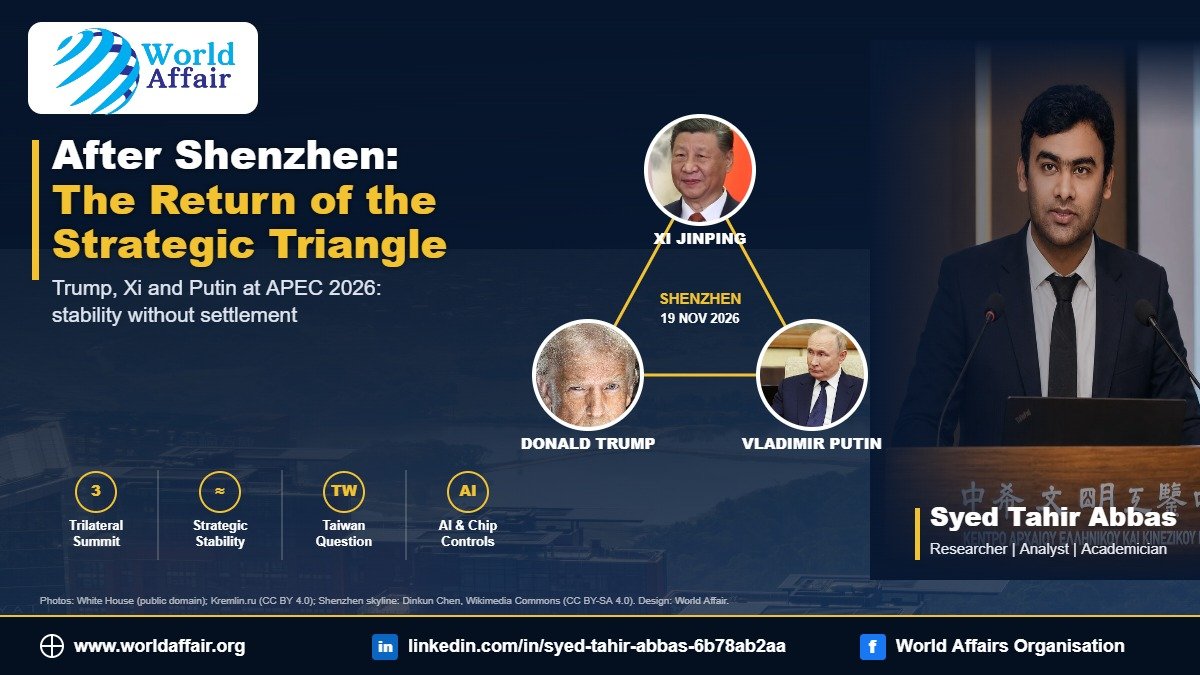
On 19 November 2026, in a villa in Shenzhen, the leaders of the United States, China and Russia sat at the same table for the first time in modern diplomatic history. Donald Trump, Xi Jinping and Vladimir Putin posed for a “family photo”, talked behind closed doors for about 55 minutes, and left with a short “Declaration toward Peace”. On the same day, Trump and Xi held their own meeting – their third face-to-face meeting of 2026 – and agreed to draft an “action plan” for what Beijing now calls a “constructive China–US relationship of strategic stability”.
Before the summit, I asked in APEC Shenzhen 2026: Can the Trump–Xi Truce Survive Its Biggest Test Yet? whether the fragile trade peace between Washington and Beijing would be renewed in Shenzhen. The answer is now clear: the truce survived, but it was not extended. Shenzhen produced warm words, a historic photograph and a new framework, but very few concrete commitments. In this article I look at what really happened, what it means, and why a historian of the Cold War cannot look at that three-way photograph without thinking of 1972.
What Happened in Shenzhen
The APEC Economic Leaders’ Meeting took place in Shenzhen on 18–19 November under the theme “Building an Asia-Pacific Community to Prosper Together”. It was only the third time China has hosted the leaders’ meeting, after Shanghai in 2001 and Beijing in 2014. All 21 economies adopted the 2026 APEC Leaders’ Declaration by consensus, setting out a “Shenzhen Outlook” for the region, with separate documents on trade, connectivity and innovation. China also used its host year to push again for the Free Trade Area of the Asia-Pacific (FTAAP), but the declaration set no timetable for it.
Most of the world, however, was watching three meetings on the sidelines:
- Trump and Xi met for about an hour. Both sides called the meeting positive and constructive and agreed to draft an action plan for “strategic stability”.
- Trump and Putin met separately. Kremlin aide Yury Ushakov said they discussed the war in Ukraine and bilateral issues, and that the meeting “went well”.
- Trump, Xi and Putin met together for the first time and signed a “Heads of State Declaration toward Peace”.
A Historic Photograph, a Modest Declaration
The trilateral meeting was clearly the symbolic centre of the summit. Xi Jinping said it had “groundbreaking significance” and that great powers should work together on global challenges. Trump said the three countries were “uniquely positioned” to discuss nuclear weapons, an issue he had insisted on placing at the centre of the meeting despite Beijing’s repeated objections to three-way arms control talks. Putin, for his part, made clear that Ukraine would be his focus.
The declaration they signed is broad but thin. According to reports of its contents, the three leaders committed to pursue reform of the United Nations, to increase the production and supply of refined petroleum products and keep energy flows stable, to recognise the importance of the immunities of state officials, and to hold dialogue on reducing nuclear risks and preventing proliferation. What it does not contain is just as important: there are no concrete steps on the wars in Ukraine or with Iran, and no road map for nuclear arms control, let alone disarmament.
In other words, Shenzhen was a meeting about the possibility of great-power cooperation, not about cooperation itself. That does not make it meaningless. In diplomacy, the first meeting is often about establishing that a channel exists. But we should be careful not to confuse a photograph with a settlement.
Trump and Xi: “Strategic Stability” and Its Limits
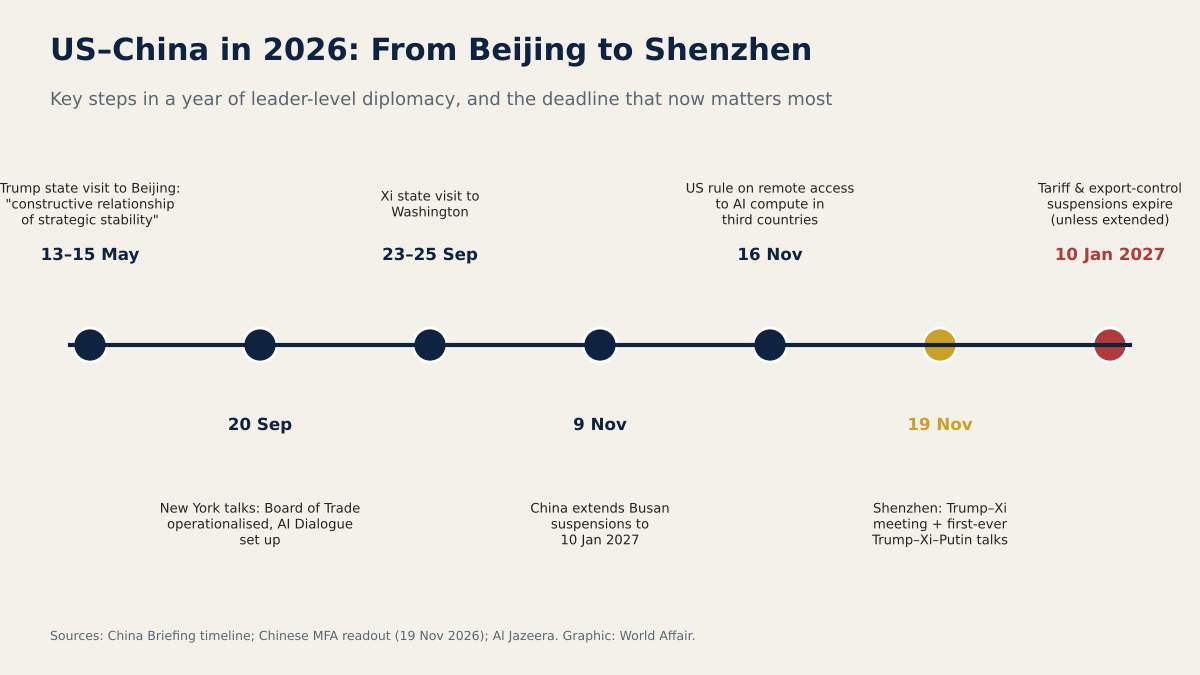
The language of the US–China relationship has changed a great deal this year. When Trump made his state visit to Beijing on 13–15 May, the two sides adopted the phrase “constructive China–US relationship of strategic stability”. In September, Xi made a state visit to Washington, and the two governments set up an AI dialogue and put the new US–China Board of Trade into operation. In Shenzhen, Xi described relations as “stable and improving” and asked for “a longer list of cooperation and a shorter list of problems”. Trump called Xi a “friend” and spoke of a “special relationship”.
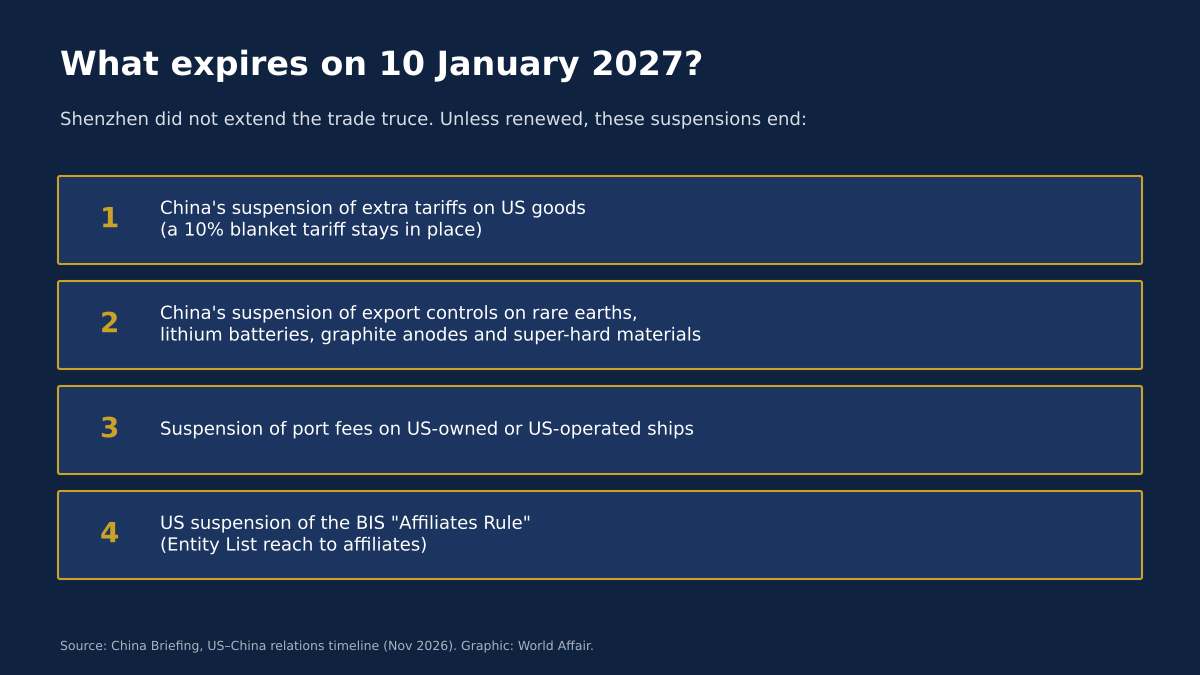
Yet under the warm language, the hard issues are unchanged. Shenzhen produced no lasting trade deal and no new extension of the truce agreed in Busan in October 2025. The reciprocal suspensions – which were already extended once, to 10 January 2027 – still expire on that date. And only three days before the summit, on 16 November, the US Commerce Department’s Bureau of Industry and Security issued a new rule requiring licences for exports of advanced AI chips to data centres in third countries that give Chinese companies remote access to large amounts of computing power. China’s Foreign Ministry accused Washington of “abusing export control measures”.
This is the pattern of US–China relations in 2026: stability at the top, competition everywhere below it. Leaders meet, praise each other and agree on frameworks, while officials continue to tighten controls on technology and to bargain hard on trade. “Strategic stability” does not mean the rivalry is over. It means both sides want to manage it without a crisis, at least for now.
Taiwan: One Sentence, Two Readings
The most sensitive line of the summit concerned Taiwan. According to China’s official readout, Xi urged the United States to “keep doing the right thing” on Taiwan, and Trump said that the United States does not support “Taiwan independence”. Chinese state media gave this sentence great prominence.
Three cautions are needed. First, the sentence comes from the Chinese readout; at the time of writing I have not seen a US readout or White House statement confirming the exact wording. Second, Taiwan’s Mainland Affairs Council Minister Chiu Chui-cheng rejected the Chinese media reports, saying Taipei “maintains close communication with the US side”. Third, even if Trump did use those words, they would not be entirely new. Since the Shanghai Communiqué of February 1972, the United States has said that it “acknowledges” the position of Chinese on both sides of the Strait that there is but one China, and “does not challenge that position”. Successive US governments have said they do not support Taiwan independence while also opposing any change to the status quo by force.
What is new is the emphasis. A US president who speaks of a “special relationship” with Xi, and who has said he is “not looking to have somebody go independent”, gives Beijing more room to present American policy in its own words. For Taipei, the risk is not one sentence but a slow drift in tone, decided in meetings where Taiwan has no seat.
Artificial Intelligence: Cooperation in Words, Competition in Practice
Artificial intelligence is now part of every US–China meeting. In Shenzhen, Xi proposed stronger coordination on AI security risks and said that AI should “always” remain under human control. Trump spoke of cooperation on what he calls “super intelligence”, but in the APEC discussions he also said that the United States opposes “any form of globalist regulation or anything to control or stifle” it. The 21 economies agreed on a number of outcomes on digital trade and AI, but there was no agreement on the central question: who should govern AI, and by what rules.
As I argued in The AI Choice Is Becoming Binary, the real AI competition is fought through chips, data centres and standards, not through summit statements. The 16 November rule on remote access to computing power shows that Washington’s priority is still to slow China’s access to the most advanced computing, even while it talks about cooperation on safety.
From Nixon’s Triangle to Trump’s
As a historian of Sino-American relations, I find the Shenzhen photograph most interesting for what it says about the “strategic triangle”. In 1972, Richard Nixon visited Beijing in February and Moscow in May. His adviser Henry Kissinger built a strategy on a simple idea: the United States should have better relations with China and with the Soviet Union than those two communist powers had with each other. After the Sino-Soviet split, Beijing and Moscow were rivals, and Washington could sit at the “pivot” of the triangle.
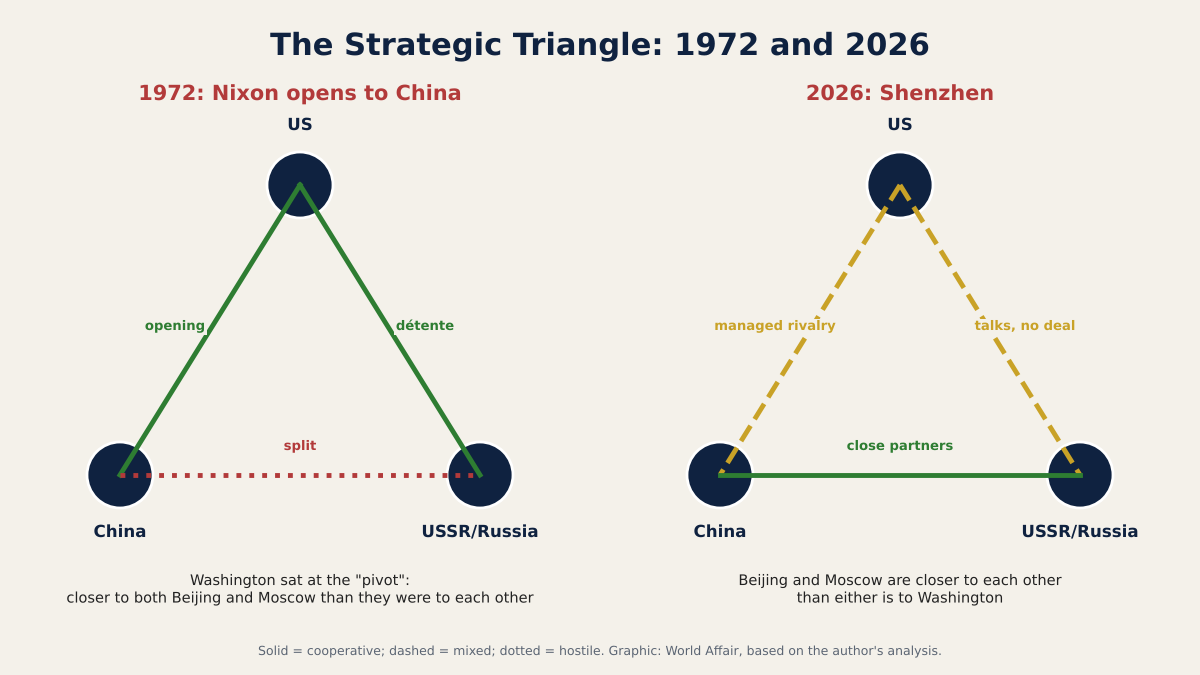
Fifty-four years later, the triangle has turned around. Today China and Russia describe their partnership in the warmest terms, while each has a difficult and competitive relationship with the United States. In Shenzhen it was Xi, not Trump, who hosted the three-way meeting and who could present himself as the leader bringing the others together. Some commentators have spoken of a “reverse Kissinger” strategy, in which Washington tries to pull Moscow away from Beijing. Shenzhen offered no evidence that this is working. Putin came to talk about Ukraine; Xi came to show China as the centre of Asian diplomacy; and Trump came for a deal on nuclear risks that he did not get.
There is one more lesson from 1972. Nixon’s opening to China did not happen in one summit. It took more than two years of secret messages – many of them carried through Pakistan – before Kissinger could fly to Beijing. Real changes in great-power relations are slow, quiet and built on many small steps. Shenzhen may turn out to be one such step, or it may be remembered only for its photograph. The action plan that Trump and Xi have promised will tell us which.
What It Means for Asia and the Global South
For the other APEC economies, from Japan and South Korea to Vietnam, Indonesia and Australia, Shenzhen brought some relief: the two largest economies are talking rather than escalating, and the regional declaration was adopted by consensus. But businesses and governments still face uncertainty, because the key trade suspensions run out in January and export controls continue to widen. The new US chip rule also names Indonesia, Malaysia, Singapore, Thailand and Brazil as destinations that now need licences, which shows how the technology rivalry reaches far beyond the US and China.
For countries of the Global South, including Pakistan, the message is mixed. A great-power dialogue on energy supply and nuclear risk is welcome, especially for countries hit hard by this year’s energy shocks. But a world in which a few great powers decide the big questions among themselves leaves little room for others. Pakistan, which in 1971 carried Nixon’s messages to Beijing and in 2026 has again tried to play a bridging role, including by hosting US–Iran talks in April, knows both the value and the limits of being a channel between great powers.
What to Watch Before 10 January 2027
- The action plan: Will Washington and Beijing publish the promised plan for a “strategically stable” relationship, and will it include real mechanisms, such as military communication or crisis hotlines?
- The truce deadline: Will the tariff, export-control and port-fee suspensions be extended again before 10 January, or replaced by a broader deal through the Board of Trade?
- Technology controls: How will China respond to the 16 November rule on remote access to AI computing power?
- Taiwan: Will Washington confirm or clarify the Chinese account of what Trump said, and how will Taipei and Congress respond?
- The trilateral track: Will the three powers hold any follow-up dialogue on nuclear risk reduction, as the declaration promises?
Conclusion
Shenzhen was a summit of symbols. It gave us the first meeting of the American, Chinese and Russian leaders, a new vocabulary of “strategic stability”, and a declaration with many good intentions. It did not give us a trade deal, an arms control process or a settlement of any of the wars that shape this year’s world politics. The great powers have agreed to keep talking. That is better than the alternative. But history teaches that the real work of diplomacy begins after the photograph is taken – and the first test of that work will come on 10 January 2027.
Sources
- Ministry of Foreign Affairs of the People’s Republic of China, “President Xi Jinping Meets with U.S. President Donald J. Trump”, 19 November 2026.
- Al Jazeera, “Trump meets Putin and Xi for trilateral US, Russia, China talks at APEC”, 19 November 2026.
- China Briefing, “US–China Relations in the Trump 2.0 Era: A Timeline” (updated November 2026).
- Latin Times, “APEC summit ends with a declaration, a historic Trump–Xi–Putin meeting and no agreement on who should govern AI”, November 2026.
- Taiwan News, “Xi presses Trump on Taiwan at APEC summit”, November 2026.
- Joint Communiqué of the United States of America and the People’s Republic of China (Shanghai Communiqué), 28 February 1972.
Note: AI tools were used only to check grammar and sentence structure. The research, analysis and views are the author’s own.
Author Profile
- Syed Tahir Abbas is a Master's student at Southwest University, Chongqing, specializing in international relations and sustainable development. His research focuses on U.S.-China diplomacy, global geopolitics, and the role of education in shaping international policies. Syed has contributed to academic discussions on political dynamics, economic growth, and sustainable energy, aiming to offer fresh insights into global affairs.
Latest entries
 GeopoliticsNovember 22, 2026After Shenzhen: Trump, Xi and Putin at APEC 2026 and the Return of the Strategic Triangle
 US-China RelationsNovember 2, 2026APEC Shenzhen 2026: Can the Trump–Xi Truce Survive Its Biggest Test Yet?
 GeopoliticsOctober 30, 2026Truce on a Timer: Why the US–China Trade Peace Now Runs Two Months at a Time
 GeopoliticsSeptember 21, 2026Xi-Trump Summit 2026: Can Managed Competition Survive the AI and Power Reality?