Table of Contents
By Syed Tahir Abbas | World Affair | 2 November 2026
On 18–19 November 2026, leaders of the 21 Asia-Pacific Economic Cooperation (APEC) economies will meet in Shenzhen, the southern Chinese city that grew from a fishing town into one of the world’s great technology hubs. It is only the third time China has hosted the APEC leaders’ meeting, after Shanghai in 2001 and Beijing in 2014. But this year, most of the world will be watching one meeting on the sidelines: Donald Trump and Xi Jinping, sitting down for the third time in six months.
Their trade truce now runs only until 10 January 2027. As I argued in Truce on a Timer, the peace between the world’s two largest economies is now being renewed a few weeks at a time. APEC Shenzhen is the moment when we learn whether that timer gets reset again, or whether the two sides can finally agree on something that lasts.
Why APEC Shenzhen 2026 Matters
APEC is not a small club. Its 21 member economies produced about 61% of world GDP and around 46% of global trade in 2024, and they are home to nearly 3 billion people. APEC itself forecasts regional growth of about 3.2% in 2026 and 3.0% in 2027. When the US and China disagree, it is APEC’s members – from Japan and South Korea to Vietnam, Indonesia and Australia – who feel it first.
China has chosen the theme “Building an Asia-Pacific Community to Prosper Together”, with three priorities announced in December 2025:
- Openness – support for the multilateral trading system, stable supply chains and deeper connectivity;
- Innovation – cooperation on frontier technologies such as artificial intelligence, digital public services and common standards;
- Cooperation – on food security, energy, small businesses, transport, tourism and public health.
Foreign Minister Wang Yi has said Beijing wants a “substantive outcome document” from the leaders. China is also pushing again for the long-discussed Free Trade Area of the Asia-Pacific (FTAAP). For Beijing, hosting in Shenzhen is a chance to show that China – not Washington – is the country standing up for open trade in Asia.
The Road to Shenzhen: How We Got Here
To understand what is at stake, we need to remember how quickly this relationship has moved in the past year:
- 30 October 2025 – Busan: Trump and Xi agreed a truce. The US cut some tariffs and China paused its expanded rare-earth export controls. The truce was set to end on 10 November 2026.
- May 2026 – Beijing: Trump visited China. The two sides agreed new trade and investment boards and tariff cuts on about US$30 billion of goods.
- 23–26 September 2026 – Washington: Xi made a state visit. Treasury Secretary Scott Bessent announced that the truce would be extended to 10 January 2027. The two sides also agreed to set up a US–China AI dialogue, a crisis-communication memorandum and Chinese purchases of US coal. Both leaders said they would attend each other’s summits – APEC in Shenzhen and the G20 in Miami in December.
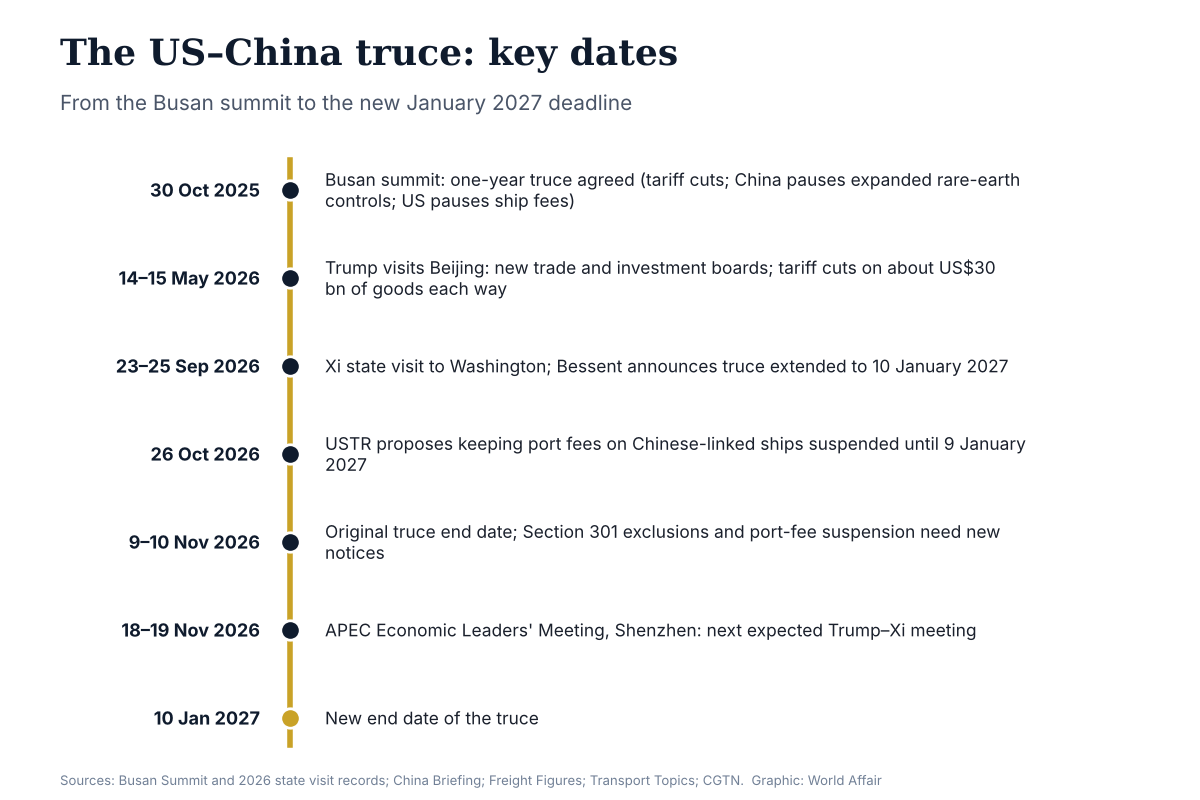
So Shenzhen is not a fresh start. It is the middle step of a three-step calendar: APEC in November, the G20 in December, and the truce deadline in January. What happens in Shenzhen will shape the other two.
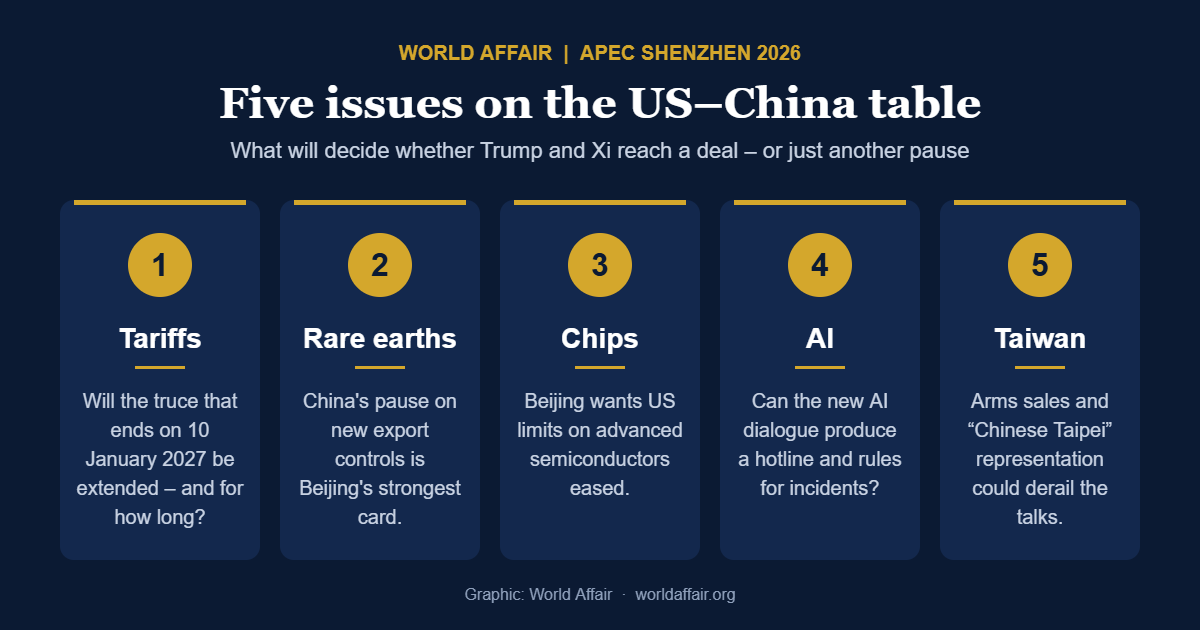
Five Issues on the Table
1. Tariffs and the January deadline
The most immediate question is simple: will the truce be extended again, and for how long? A second issue arrives even before the summit. A list of 178 Chinese products that are excluded from US Section 301 tariffs – including 14 types of solar-manufacturing equipment – is legally due to expire at the end of 9 November 2026 unless the US Trade Representative extends it. A further short extension is likely, but businesses on both sides of the Pacific are tired of planning around deadlines that are only weeks away. A longer framework – six months or a year – would be the clearest sign of real progress.
2. Rare earths and critical minerals
China controls most of the world’s rare-earth processing, and its pause on new export controls was the most valuable thing it gave in Busan. According to analysts at CSIS, Washington is still unhappy with the flow of rare-earth exports to the US and Japan, and Xi did not publicly address those concerns in September. This is Beijing’s strongest card, and it is unlikely to give it up without something big in return.
3. Chips and export controls
On the other side, Beijing’s top complaint is US restrictions on advanced semiconductors and the long list of Chinese companies that American firms cannot do business with. Any movement on chips would be a major political story in Washington. That makes it the hardest issue to trade – and the one to watch most closely in any joint statement.
4. Artificial intelligence
AI may be the most important new item. In September, the two sides agreed to a dialogue on AI risks – which the US side called a “Safety Dialogue on Super Intelligence” – and to set up communication channels for AI-related incidents. The next round was planned for November 2026. AI is also one of China’s APEC priorities: APEC digital and AI ministers met in Chengdu in July and agreed a joint statement on AI for growth, digital skills and a trusted digital environment. But as CSIS notes, operational details are still thin. If Shenzhen produces a working hotline or clear rules for AI incidents, it would be the first real “guardrail” for the technology between the two powers. I have written before about how the AI choice is becoming binary for other countries; a US–China AI channel would not end that pressure, but it could lower the risk of accidents.
5. Taiwan and security
Taiwan is always present, even when it is not on the official agenda. Taiwan takes part in APEC as “Chinese Taipei”, and who represents it in Shenzhen is a sensitive question. In September, Xi urged Washington to oppose “Taiwan independence”, while Taiwan’s legislature has passed a large special defence budget mostly to buy US weapons. At the same time, China has been widening its maritime pressure, including coast guard patrols east of Taiwan. A summit on Chinese soil gives Xi home advantage to push this issue. A US arms sale announced near the summit could quickly undo the goodwill.
Beyond Trade: A Bigger Diplomatic Stage
Shenzhen could also be about more than trade. In October, Trump said he was open to a summit with Xi and Russia’s Vladimir Putin on nuclear arms control, and there has been speculation about other meetings on the sidelines. Nothing has been confirmed, and such ideas often change quickly. But it shows how APEC has become a stage for great-power diplomacy, not only for tariff talks. For US allies such as Japan, South Korea and Australia, the worry is that big decisions about their region could be made in meetings they are not part of.
Three Possible Outcomes
- Another short pause (most likely). The leaders meet, speak warmly, and extend the truce by a few more months. Markets relax, but the real disputes – chips, rare earths, Taiwan – stay unsolved.
- A longer framework (possible). The two sides agree a six- to twelve-month deal, with clear steps on tariffs, rare earths and AI channels, to be finalised at the G20 in Miami. This would be the best result for the world economy.
- A breakdown (less likely, but real). A Taiwan incident, a new chip restriction or a rare-earth dispute derails the talks, and the January deadline passes with tariffs rising again.
What APEC Shenzhen Means for Pakistan and South Asia
Pakistan is not an APEC member – no new economy has joined the forum since 1998 – but it is deeply exposed to what happens there. In FY2025–26, the United States was Pakistan’s largest export market, while China was its second-largest. Pakistan’s largest trade deficit, about US$16.9 billion, was with China. In simple terms, Pakistan sells to America and buys from China.
That means a stable US–China truce is good news for Islamabad: it keeps freight costs, input prices and demand for Pakistani textiles more predictable. A breakdown would hurt Pakistan twice – through weaker demand in the US and more expensive or uncertain supplies from China. It could also increase pressure on Pakistan to “choose sides” on technology, from telecoms to AI, while projects under the China–Pakistan Economic Corridor (CPEC) continue. For South Asia as a whole, the lesson is clear: our economic future is being shaped in rooms where we do not have a seat, so our diplomacy must stay balanced and active.
Conclusion: A Summit About Time
APEC Shenzhen 2026 will be full of images – handshakes, a skyline of glass towers, a group photo of 21 leaders. But the real question is about time. Since Busan, the US and China have treated their truce like a phone that is always on low battery, charging it for just a few weeks at a time. If Trump and Xi leave Shenzhen with a longer deal, real AI guardrails and calmer language on Taiwan, the Asia-Pacific – and countries like Pakistan – can plan ahead again. If they leave with only another short extension, the world will be back on the timer by Christmas.
For more background, read my earlier analysis: Xi–Trump Summit 2026: Can Managed Competition Survive the AI and Power Reality?
Frequently Asked Questions
When and where is APEC 2026?
The APEC Economic Leaders’ Meeting is on 18–19 November 2026 in Shenzhen, Guangdong, China. The APEC CEO Summit runs on 17–18 November.
Will Trump and Xi meet at APEC Shenzhen?
Yes, both leaders said after Xi’s September 2026 state visit to Washington that they would meet at APEC in Shenzhen and again at the G20 in Miami in December.
When does the US–China trade truce end?
The truce agreed in Busan in October 2025 was extended in September 2026 and now runs until 10 January 2027.
What is the theme of APEC 2026?
China’s theme is “Building an Asia-Pacific Community to Prosper Together”, with three priorities: openness, innovation and cooperation.
Is Pakistan a member of APEC?
No. Pakistan is not an APEC member, but because the US is its largest export market and its biggest trade deficit is with China, US–China decisions at APEC affect Pakistan’s economy directly.
Sources
- APEC China 2026 – Wikipedia
- APEC: China Unveils APEC 2026 Theme and Priorities in Shenzhen
- APEC: Digital and AI Ministers Issue Joint Statement (July 2026)
- CGTN: APEC 2026 – 30 days to go until Shenzhen hosts world leaders
- 2026 state visit by Xi Jinping to the United States – Wikipedia
- CSIS: Takeaways from the Trump–Xi White House Summit
- FreightFigures: Section 301 China exclusions expire November 2026
- The Korea Times: APEC – China’s role to revitalize Asia-Pacific economy
- Axios: Trump open to summit with Xi and Putin (19 October 2026)
Author Profile
- Syed Tahir Abbas is a Master's student at Southwest University, Chongqing, specializing in international relations and sustainable development. His research focuses on U.S.-China diplomacy, global geopolitics, and the role of education in shaping international policies. Syed has contributed to academic discussions on political dynamics, economic growth, and sustainable energy, aiming to offer fresh insights into global affairs.
Latest entries
 US-China RelationsNovember 2, 2026APEC Shenzhen 2026: Can the Trump–Xi Truce Survive Its Biggest Test Yet?
 GeopoliticsOctober 30, 2026Truce on a Timer: Why the US–China Trade Peace Now Runs Two Months at a Time
 GeopoliticsSeptember 21, 2026Xi-Trump Summit 2026: Can Managed Competition Survive the AI and Power Reality?
 GeopoliticsSeptember 7, 2026China’s New Front: Coast Guard Patrols East of Taiwan and the Quiet Expansion of Maritime Pressure in 2026