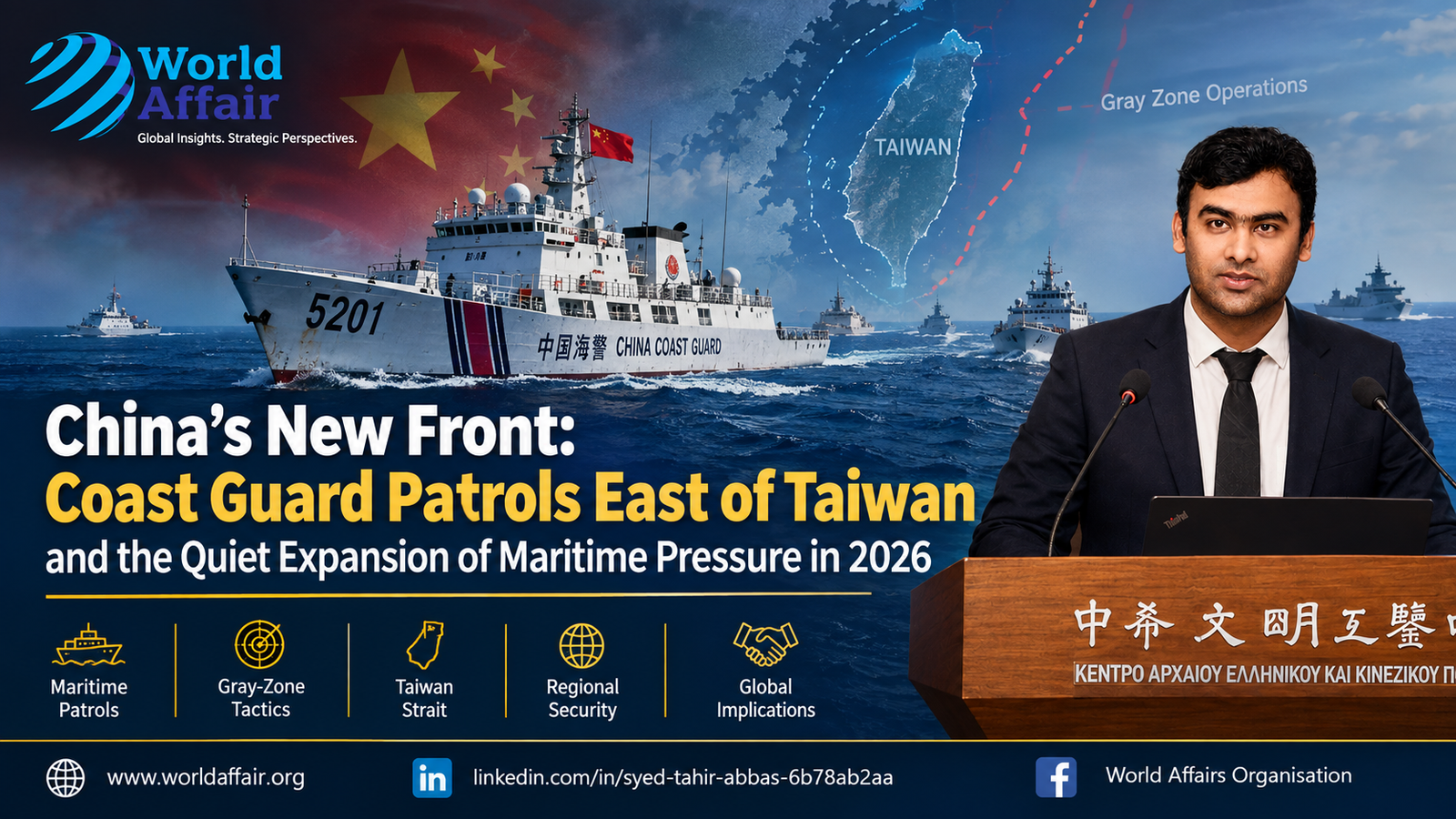
In the opening days of September 2026, reports confirmed that China has sustained and expanded a campaign of continuous China Coast Guard (CCG) patrols in the waters east of Taiwan. What began in early June as a response to Japan-Philippines maritime boundary talks has evolved into a near-permanent presence covering tens of thousands of square nautical miles of the Western Pacific. Beijing describes these operations as “routine law enforcement.” Taipei and regional observers see them as a deliberate effort to normalize Chinese jurisdiction over waters critical to Taiwan’s eastern approaches and to any potential military contingency.
This development marks a significant evolution in China’s gray-zone strategy against Taiwan. For decades, pressure focused primarily on the Taiwan Strait and the western approaches. The shift to the Pacific coast opens a new front that complicates Taiwan’s defensive geography, challenges the freedom of navigation in vital sea lanes, and tests the responses of the United States, Japan, and other regional partners. This article examines the origins, operational pattern, strategic logic, and broader implications of this campaign.
Historical Background
China’s pressure on Taiwan has long combined military exercises, air and naval incursions into the median line of the Taiwan Strait, economic coercion, and diplomatic isolation. Coast Guard and maritime militia activities have played a growing role in asserting claims in the South China Sea and around Taiwan’s outlying islands such as Kinmen. Until 2026, however, sustained “law enforcement” presence east of the main island remained limited or episodic.

The catalyst for the current campaign was the May 28, 2026, Japan-Philippines joint statement announcing plans to delimit their overlapping exclusive economic zones (EEZs) and continental shelves in waters east of Taiwan. China strongly protested the talks as illegal and a violation of its claimed rights, arguing that Taiwan is part of China and that third parties cannot negotiate boundaries in these waters without Beijing’s involvement. Within days, CCG vessels appeared and began what officials later termed continuous operations.
Current Situation
Since June 1, 2026, China has maintained an average of two Coast Guard cutters per month on station east of Taiwan. Initial deployments involved the 5,000-ton Daishan and 3,000-ton Baita. These were later relieved by other formations, including the Xiushan and subsequent groups, demonstrating an intent to rotate forces and sustain presence rather than conduct one-off signaling.
Ship-tracking data indicate that patrols have covered approximately 27,100 square nautical miles — more than twice the land area of Taiwan — while generally remaining outside Taiwan-claimed territorial waters, typically staying around 30 nautical miles from the eastern coast. Taiwan’s Coast Guard has monitored the vessels, describing the activity as “pseudo-law enforcement” and an attempt to expand control. Chinese spokesmen insist the patrols safeguard navigation order and the rights of Chinese (including Taiwanese) fishermen.
Latest Developments
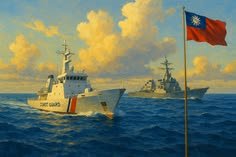
As of early September 2026, the campaign continues with fresh rotations and accompanying scientific survey vessels. Chinese statements emphasize that operations will be strengthened. Concurrent research activity near undersea infrastructure has raised additional concerns about mapping and intelligence gathering. The pattern coincides with broader Chinese efforts to project presence beyond the first island chain.
Political Analysis
Domestically in China, the patrols reinforce the narrative of sovereignty over Taiwan and its surrounding waters. For Taiwan’s leadership, the eastern front adds a new dimension of resource strain on coast guard and naval assets already stretched by Strait activity. Regionally, the operations respond to closer Japan-Philippines security coordination and serve as a warning against further delimitation efforts that exclude Beijing.
International Relations Perspective
From a realist perspective, the campaign is a classic example of salami-slicing: incremental changes that alter the status quo without triggering a decisive response. Liberal institutionalists highlight the challenge to UNCLOS principles of exclusive economic zones and freedom of navigation. The dual character of Coast Guard operations — law enforcement in form, power projection in effect — blurs traditional distinctions between civilian and military domains.
Strategic Analysis
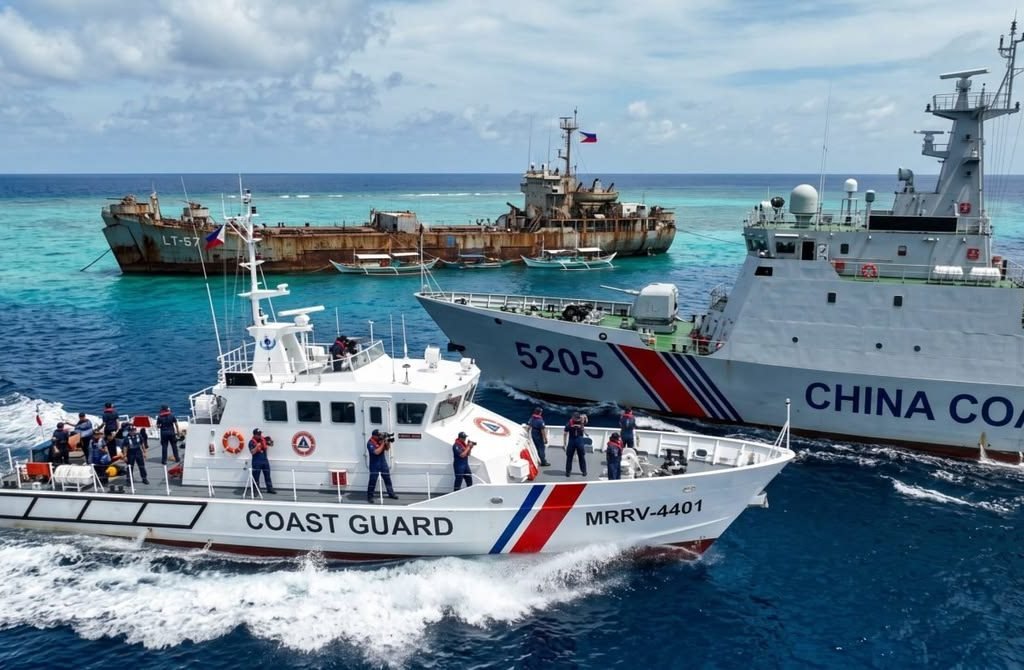
The eastern waters are strategically vital. They form part of Taiwan’s defensive depth and would be critical for reinforcement or escape routes in a blockade or invasion scenario. By normalizing CCG presence, China creates a foundation for potential future restrictions on commercial or military traffic, complicates U.S. and Japanese operational planning, and signals that Beijing claims administrative authority over a much wider maritime domain around Taiwan. This aligns with longer-term efforts to erode the second island chain’s utility for American power projection.
Economic Implications
The Western Pacific routes east of Taiwan carry significant commercial traffic. Sustained Chinese presence increases uncertainty for shipping, insurance costs, and potential future restrictions. Undersea cables and energy infrastructure in the area also face heightened scrutiny.
Military Implications
Coast Guard cutters, while not warships, are large, heavily armed by coast guard standards, and operate under a legal framework that allows assertive interdiction. Continuous presence enables better situational awareness, potential coordination with PLA Navy forces, and the ability to harass or delay vessels. It also forces Taiwan and partners to divert monitoring resources.
China’s Perspective
Beijing frames the patrols as legitimate law enforcement within waters under its jurisdiction. Official statements link the activity to protecting Chinese rights and maintaining order, while rejecting any implication that Taiwan possesses independent maritime entitlements. The Japan-Philippines talks are portrayed as provocative interference.

US Perspective
Washington has long opposed unilateral changes to the status quo around Taiwan. Expanded Chinese presence east of the island raises concerns about freedom of navigation and the credibility of U.S. commitments. Responses are likely to include continued freedom-of-navigation operations, enhanced intelligence sharing with Taiwan and allies, and diplomatic messaging against coercion.
European Perspective
European states generally support freedom of navigation and UNCLOS but maintain limited direct military presence in the Western Pacific. Statements of concern and support for dialogue are the primary tools available.
Asian Perspective
Japan views the patrols as directly relevant to its own southern island security and EEZ interests. The Philippines sees parallels with South China Sea gray-zone tactics. Taiwan faces the most immediate operational and political pressure. ASEAN as a whole remains cautious, balancing economic ties with China against principles of maritime order.
Global South Perspective
Many developing countries prioritize non-interference and economic relations with China. While supportive of UNCLOS in principle, few are willing to confront Beijing directly over Taiwan-related maritime issues.
Analysis
Analysts describe the campaign as a successful normalization effort. By rotating vessels and maintaining continuous presence for months, China has established a new operational baseline that will be difficult to reverse without significant political or military cost. The linkage to Japan-Philippines delimitation talks provided a convenient political pretext, but the underlying objective appears broader: asserting comprehensive jurisdiction around Taiwan.
Future Scenarios
- Sustained low-level presence becomes the accepted new normal.
- Further expansion of patrol frequency, area, or assertiveness, including closer approaches or interdictions.
- Coordinated responses by Taiwan, Japan, the United States, and partners that raise the costs of the campaign.
- Spillover into incidents involving commercial or third-party vessels.
Challenges
Key difficulties include the asymmetry of resources, the dual civilian-military nature of Coast Guard operations, alliance coordination challenges, and the risk that gradual normalization goes unchallenged until the cumulative effect is irreversible.
Policy Recommendations
- Enhance maritime domain awareness and real-time monitoring sharing among Taiwan, Japan, the United States, and partners.
- Conduct regular, transparent freedom-of-navigation and presence operations in the affected waters.
- Strengthen Taiwan’s coast guard capacity and resilience.
- Maintain consistent diplomatic messaging that rejects unilateral changes to the status quo.
- Accelerate Japan-Philippines delimitation talks while managing escalation risks.
- Develop clearer crisis communication channels to prevent miscalculation.
Conclusion
China’s sustained Coast Guard campaign east of Taiwan represents one of the most significant gray-zone developments of 2026. By moving from episodic signaling to continuous presence, Beijing is attempting to rewrite the operational and legal map of the Western Pacific around Taiwan. The success or failure of this effort will influence not only cross-Strait dynamics but the broader contest over maritime order in the Indo-Pacific. Vigilant monitoring, coordinated responses, and clear red lines remain essential if the rules-based system is to retain meaning in these waters.
FAQ
1. When did China begin continuous patrols east of Taiwan?
In early June 2026, following Japan-Philippines announcements on EEZ delimitation talks.
2. How large an area do the patrols cover?
Approximately 27,100 square nautical miles according to ship-tracking analysis.
3. Do the vessels enter Taiwan’s territorial waters?
Generally they remain outside, typically around 30 nautical miles from the eastern coast.
4. Why does China say it is conducting these patrols?
Beijing describes them as routine law enforcement to maintain order and protect the rights of Chinese fishermen, including those from Taiwan.
5. How has Taiwan responded?
Taiwan monitors the vessels closely and has characterized the activity as political expansion disguised as law enforcement.
6. What triggered the campaign?
Primarily the May 2026 Japan-Philippines decision to begin maritime boundary negotiations in the overlapping EEZ area east of Taiwan.
7. Are these military or civilian operations?
China frames them as Coast Guard law enforcement; critics view them as gray-zone power projection with clear strategic intent.
8. What are the strategic risks?
Normalization of Chinese presence could complicate Taiwan’s eastern defenses, undersea infrastructure security, and freedom of navigation in a crisis.
9. How do the United States and Japan view this?
As a concerning unilateral change that challenges the status quo and requires monitoring and calibrated responses.
10. Could this lead to direct confrontation?
The pattern so far prioritizes gradualism over high-risk incidents, but close-quarters operations always carry the possibility of miscalculation.
Author Profile

- Syed Tahir Abbas is a Master's student at Southwest University, Chongqing, specializing in international relations and sustainable development. His research focuses on U.S.-China diplomacy, global geopolitics, and the role of education in shaping international policies. Syed has contributed to academic discussions on political dynamics, economic growth, and sustainable energy, aiming to offer fresh insights into global affairs.
Latest entries
 GeopoliticsSeptember 21, 2026Xi-Trump Summit 2026: Can Managed Competition Survive the AI and Power Reality?
 GeopoliticsSeptember 7, 2026China’s New Front: Coast Guard Patrols East of Taiwan and the Quiet Expansion of Maritime Pressure in 2026
 Strategic AssessmentAugust 24, 2026The AI Choice Is Becoming Binary: Washington’s Push and Beijing’s Counter
 GeopoliticsJuly 28, 2026South China Sea Crisis Deepens: China-Philippines Standoff and the Future of Indo-Pacific Order